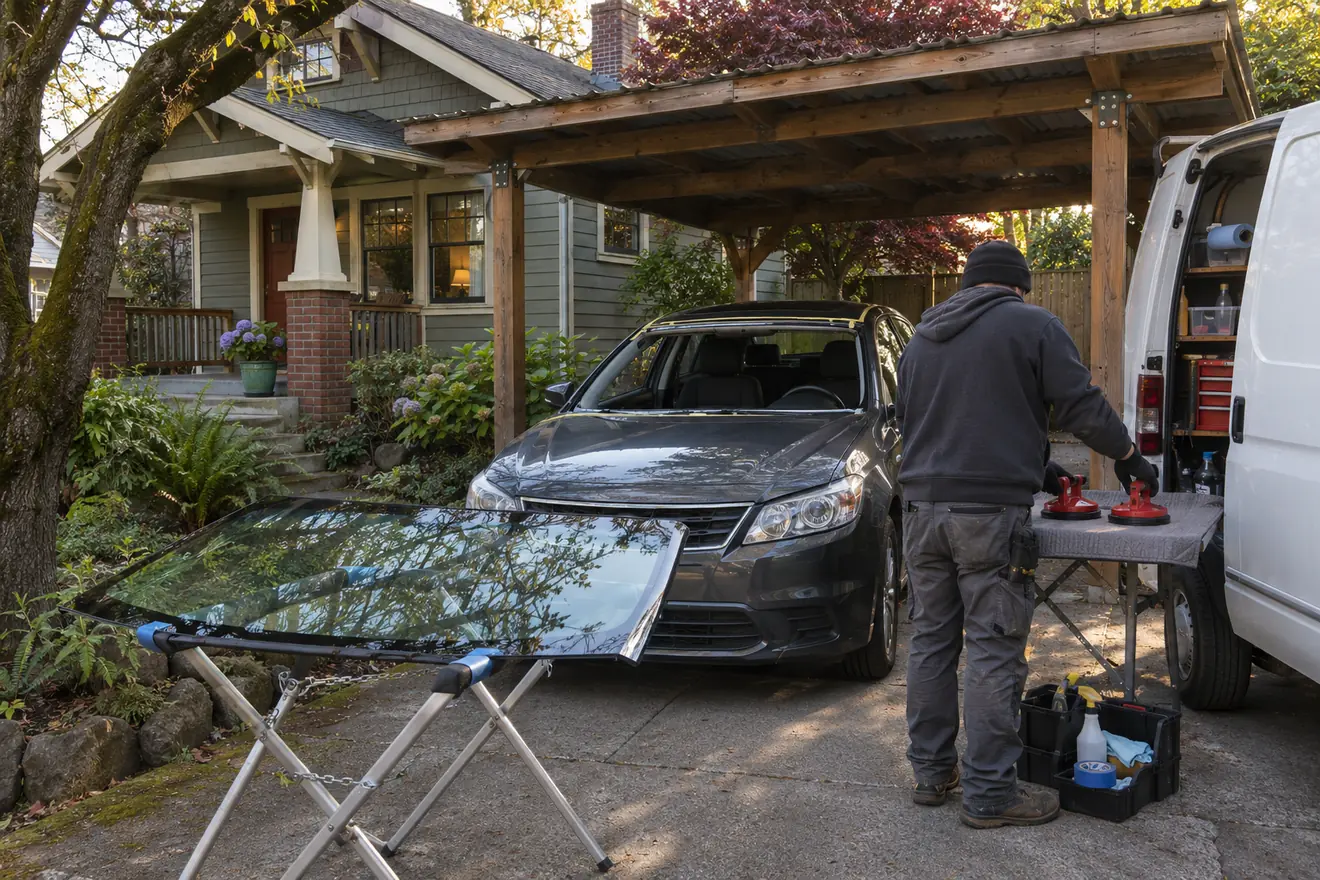
Mobile windshield replacement in Portland means a technician drives to your home, workplace or parking spot and installs the new glass on site, in a standard parking space or driveway. Most passenger cars, pickups and SUVs qualify. A typical job takes 60 to 90 minutes, followed by a drive-away wait. The jobs that need extra planning are vehicles that require static ADAS calibration, heated or specialty glass, and rainy days with no covered spot.
The sections below explain how a mobile appointment works step by step, which jobs fit, how coverage across the metro works, how to prepare, what to ask a provider before booking, and what changes when insurance is involved. A mobile technician can come to an apartment lot in Sellwood, an office garage in the Lloyd District or a driveway in Beaverton, so nobody has to fight traffic on I-84 or find a ride home.
What "Mobile" Actually Means for Auto Glass Service
Mobile auto glass service means the technician arrives in a fully equipped service vehicle carrying replacement glass panels, professional cutting and removal tools, urethane adhesive systems, primer, trim clips, suction cup sets, and every other supply needed to complete a full windshield or window replacement in a standard parking space or driveway. This is not a stripped-down field repair. A properly outfitted mobile unit operates with the same professional-grade adhesives and OEM-compatible glass as a fixed shop location. The only difference is logistical: you stay put, and the technician coordinates around your address and availability.
For Portland residents, that logistical shift is significant. The metro area is geographically spread out in a way that makes cross-town trips genuinely costly in time. If you work near the Nike campus in Beaverton and live in Northeast Portland, getting a car to a shop during business hours often means arranging alternative transportation for an entire morning. A mobile appointment at your office parking lot eliminates that entirely.
Mobile service also fits Portland's car-ownership patterns. Many residents in neighborhoods like Buckman, Hosford-Abernethy, Woodstock, or the Mississippi Avenue corridor leave their vehicles street-parked all week. A mobile technician can work at the curb or in a nearby surface lot with no need to move the car to a different location. The technician brings a freestanding stand for the removed glass, handles all trim removal and reinstallation, and leaves the area clean before departing.
One underappreciated advantage: you do not have to be present for the whole job. If your car is at your workplace and you have back-to-back meetings, the technician can complete the work independently as long as the vehicle is accessible and someone confirms the location. This level of flexibility simply does not exist when you drop a car at a fixed shop.
Mobile vs. Shop: Which Is Better for Your Windshield?
For most vehicles the glass, adhesive and installation steps are the same either way; the difference is where the work happens. Use this comparison to decide.
- Choose mobile when the car is hard to move (a crack across the driver's view, a tight workday, no spare ride), when it is parked at home or work, and when the vehicle has no special calibration needs.
- Choose a shop when the vehicle needs static ADAS calibration with a target board and level floor, when the forecast is wet and you have no covered parking, or when you are replacing specialty glass such as a heated windshield or a large panoramic roof panel.
- Either works for standard windshields, side door glass and quarter glass on ordinary passenger vehicles. Ask the provider which option it recommends for your specific vehicle.
The Mobile Replacement Process, Start to Finish
Knowing the sequence of a mobile appointment sets accurate expectations and helps you plan around the job.
Scheduling and glass sourcing
When you call a provider or submit a request online, the technician or dispatcher will ask for your vehicle's year, make, model, and trim level. This information determines which windshield part number is required, and whether the panel is OEM or aftermarket glass (see the guide to OEM vs. aftermarket windshields). Most passenger vehicles, pickup trucks, and SUVs have glass available through regional distribution networks with next-day availability. A well-run provider confirms the correct panel before the appointment, so the technician arrives with the right glass already in hand rather than making a second trip after confirming fitment.
On-site setup and old glass removal
The technician parks adjacent to your vehicle and evaluates the work area. A reasonably flat, level surface with enough clearance on at least one side of the car is all that is required - most standard parking spaces qualify. The technician covers the dashboard, front seats, and surrounding trim with protective material before removing the rearview mirror, wiper arms, and cowl trim. The damaged windshield is cut free using a cold knife or power cut-out tool, lifted clear with suction cups, and safely disposed of.
Frame preparation and priming
After glass removal, the pinch weld - the metal flange that runs around the perimeter of the windshield opening - is inspected, cleaned of residual adhesive, and primed. This step separates quality installations from fast-and-cheap ones. Inadequate pinch weld preparation is one of the leading causes of water leaks and wind noise after replacement; see the guide to windshield leaks and their causes if you notice either. The primer is applied and allowed to flash (dry briefly) according to the adhesive manufacturer's instructions before any urethane is applied.
Urethane application and glass setting
Urethane adhesive is applied in a continuous, uniform bead around the prepared surface. The new windshield is positioned with suction cups and set carefully into place, pressed firmly against the bead. The technician checks the gap alignment along the roof rail and A-pillars and makes fine adjustments before the urethane begins to skin over. Once set, the glass should not move - any repositioning attempt after initial contact risks introducing voids in the adhesive bead.
Trim reinstallation and finishing
Wiper arms, cowl trim, and the rearview mirror are reinstalled. If your vehicle has a rain sensor, a factory toll transponder, or a third-party dash camera mounted to the glass, the technician can reattach compatible mounts. Vehicles equipped with front-facing ADAS cameras - used for adaptive cruise control, automatic emergency braking, and lane-keeping assist - require calibration after windshield replacement. The ADAS calibration guide covers this topic in depth; ask the provider at the time of booking whether your vehicle needs this step and how it is handled.
Drive-away guidance
Modern fast-cure urethane adhesives reach minimum safe drive-away strength within about one hour under normal conditions. The technician will confirm the specific minimum based on the adhesive product used and the ambient temperature at the time of installation. This is not arbitrary - minimum drive-away time is a safety specification tied to how the windshield performs during airbag deployment. You will also receive brief guidance on keeping a window slightly cracked for the first day and avoiding high-pressure car washes for a short period after installation.
Which Jobs Work Well for Mobile Service
The large majority of auto glass jobs in the Portland metro are good candidates for on-site mobile replacement. It helps to understand what fits easily and what may require extra planning.
Straightforward mobile jobs
- Standard windshields on passenger cars, sedans, hatchbacks, and crossovers of all sizes
- Full-size pickup truck windshields, including the Ford F-150, RAM 1500, Chevrolet Silverado, and Toyota Tundra (see pickup truck windshield replacement)
- SUV windshields from compact CUVs up to large body-on-frame models (see SUV windshield replacement)
- Side door glass (tempered front and rear door panels), including after a break-in (see car break-in window replacement)
- Rear quarter glass on sedans and hatchbacks
- Rock chip repairs, which typically take about 30 minutes and require minimal equipment (see when a rock chip repair works)
Jobs that need advance discussion
- Rear windshields with embedded defrost grids - straightforward to replace but the defrost connector must be reattached correctly; mention this when scheduling
- Panoramic and full-length sunroof panels (see sunroof and moonroof glass replacement) - some can be done mobile, others require additional tooling or a controlled setting
- Vehicles with heated windshields - these use a laminated construction with embedded wires and require a matched OEM or equivalent replacement; confirm availability when you call
- Vehicles where ADAS static calibration is required - the glass replacement itself is mobile, but static calibration may require a fixed target board and level floor; ask about how this step is handled when scheduling
When in doubt, describe the vehicle and the specific glass when you call. A technician can quickly assess whether a single mobile appointment covers everything or whether one step requires a follow-up visit.
Mobile Service Coverage in the Portland Metro
Mobile providers define their service area by drive time rather than proximity to a fixed address, so coverage differs from company to company. In the Portland area, mobile glass companies commonly cover the city itself, the east metro (Gresham, Troutdale, Fairview), Washington County (Beaverton, Hillsboro, Aloha), the south metro (Lake Oswego, Tigard, Tualatin, Wilsonville), and Clackamas County (Milwaukie, Happy Valley, Oregon City, West Linn). Service across the Columbia River into Clark County, WA, depends on routing and timing.
Questions worth asking before you book:
- Is my exact address inside the provider's normal coverage zone?
- Is there a trip charge for locations outside the core metro, such as the Tualatin Valley, Estacada, or the Columbia Gorge corridor?
- If I am north of the river, is cross-river service offered on the day I need it?
How to Check a Mobile Windshield Provider Before You Book
Because the work happens in a parking space rather than a controlled shop, the provider's process matters more than the van. These questions separate careful installers from rushed ones.
- Which adhesive will be used and what is its safe drive-away time at today's temperature? A specific answer is a good sign. A vague "about an hour" for every car is not.
- Does the company follow the AGRSS standard? The Auto Glass Safety Council (AGSC) lists registered member companies that commit to the ANSI/AGSC/AGRSS installation standard and offers an independent audit program, so you can ask whether a company is registered.
- Is the glass OEM or aftermarket, and is it matched to your trim and sensors? Rain sensors, heated elements, acoustic layers and camera brackets all vary by trim.
- How is ADAS calibration handled? Ask whether it is done on site, at a partner facility, or not offered, and get that in writing if your car has a front camera.
- What happens if it rains on the day? A provider with a clear rescheduling or covered-location policy will not rush the job to keep the slot.
- What does the warranty cover? Ask about leaks, wind noise and stress cracks, and how long each is covered.
- Who files the insurance claim and is the quote in cash or through the carrier? A written cash price lets you compare against your deductible.
Preparing for a Mobile Appointment
Mobile service is designed to be low-effort for the customer, but a few simple preparations help the technician work efficiently and protect your vehicle during the process.
Choose a stable parking spot
Pick a location where the vehicle can stay parked for the full duration of the job - plan for roughly 90 minutes to two hours including cure time before you drive away. A driveway, a numbered spot in a covered garage, or a designated space in a surface lot all work well. Street parking is fine in most cases; a spot with a bit of extra clearance on the curb side makes handling the new glass easier. Avoid spots directly beneath trees that are actively dropping sap, seed pods, or debris, particularly during Portland's spring and early summer.
Weather and temperature
Portland's climate is frequently mischaracterized as perpetually rainy. Many days are overcast and dry - ideal conditions for outdoor auto glass work. Urethane adhesive cures in temperatures as low as about 40 degrees Fahrenheit and does not require direct sunlight. What it does need is a brief window without active rainfall into the open windshield frame. On genuinely rainy mornings, a carport, the lower level of a parking structure, or a building overhang provides enough shelter to proceed. A good provider will discuss weather suitability for your appointment day and suggest alternatives if the forecast is uncertain.
Clear the dashboard and front seats
Remove loose items from the dashboard and front seats before the technician arrives. Small objects - coins, sunglasses, charger cables, parking passes - can shift or fall during trim removal. The technician lays down protective material, but a clear work area makes it easier to account for everything and avoids small items getting trapped under dash panels.
Disable rain-sensing wipers
If your vehicle has automatic rain-sensing wipers, turn the wiper switch to the off position before the appointment begins. Without this step, the wipers may activate unexpectedly when the sensor is disturbed during glass removal or reinstallation, which creates an unnecessary complication mid-job.
Provide access instructions if you will not be present
If your vehicle is in a gated or access-controlled garage, make arrangements for the technician to enter before the appointment. A parking validation code, a guest pass, or a brief meeting to badge the tech in covers this requirement. Most corporate parking operations are accustomed to service technicians accessing vehicles during business hours; a quick note to building security ahead of time eliminates any friction.
Mobile Service and Your Insurance Claim
If you carry comprehensive auto insurance, windshield replacement is typically a covered loss subject to your deductible. Many glass providers work directly with major insurers to file claims on your behalf, which means you may not need to gather a reference number and coordinate paperwork between two separate parties. Ask whether a provider handles the claim with your carrier. The insurance claim guide walks through the process.
One thing many Portland drivers do not realize: rock chip repairs are often covered with a reduced or waived deductible because the cost of repairing a chip is far lower than a full windshield replacement. Insurers generally prefer to pay a small repair bill now over a larger replacement bill when the chip cracks. If you have a fresh chip that is roughly the size of a quarter or smaller and has not yet started cracking outward, call and ask about a repair appointment before assuming full replacement is necessary. The savings are real on both sides of the transaction, and a properly repaired windshield retains its structural laminate - unlike a brand-new one that still needs its adhesive to cure to full strength.
Oregon does not have a zero-deductible glass law like certain other states, so your out-of-pocket cost depends entirely on the deductible written into your specific policy. Verify your deductible amount directly with your insurer before scheduling if cost is a primary concern. If your deductible is modest relative to the replacement cost, filing a claim is usually straightforward. If your policy was structured around low monthly premiums with a high deductible - $500 or $1,000 is common on such policies - paying out of pocket may make more financial sense, so ask providers for a cash price you can compare.
A note specific to Portland's geography: vehicles parked under mature trees in neighborhoods like Laurelhurst, Irvington, Eastmoreland, or along the forested streets of the West Hills face real windshield risk from falling branches and debris during winter storms and the spring windstorm season. Comprehensive coverage is designed exactly for these events. Have storm damage inspected as soon as it appears so the crack cannot spread further during a delay.
After the Replacement: Drive Times and Care in the First 48 Hours
Modern urethane adhesive systems are engineered to cure quickly, and most replacements allow normal driving within one hour of completion. A handful of guidelines protect the new installation during the first day or two.
Respect the minimum drive-away time
Do not drive before the technician clears the vehicle for road use. According to the Auto Glass Safety Council, minimum drive-away time is the period a vehicle should stay stationary after installation so the bond can set, and it varies with the adhesive brand and the weather at the time of replacement. Registered AGSC companies that follow the AGRSS standard are expected to hold the vehicle until that time has passed. On a warm Portland summer afternoon, cure is faster. On a 38-degree January morning, the technician may recommend a slightly longer wait. This matters because urethane that has not reached minimum strength will not hold the windshield in position if an airbag deploys or if the vehicle is involved in a rollover. Waiting an extra 20 minutes is a reasonable trade against a glass panel that fails when you need it most.
Leave one window cracked for the first day
During the first 24 hours after installation, leave one window open a small amount when driving or when closing doors. This allows cabin air pressure to equalize rather than build up against the new windshield seal every time a door is shut. A fully sealed fresh installation experiences a brief pressure spike each time a door closes; this is minor for cured urethane but puts unnecessary stress on adhesive that has not yet reached full bond strength.
Skip pressure car washes for a few days
Hold off on tunnel car washes and pressure washers for at least two to three days after replacement. Hand washing at low pressure is fine after the first 24 hours. High-pressure water directed at the perimeter of a new windshield can work past a seal that is still gaining strength along the pinch weld. This is a short-term precaution - after the urethane fully cures, normal washing is completely fine.
Keep your service invoice
Retain the service invoice and any calibration documentation in the glove box. If your vehicle has a front-facing camera system for driver assistance features, some insurers and manufacturers may request documentation confirming that the glass was replaced and the camera was properly calibrated following the work. Keeping this paperwork on hand takes no effort and has real value if a warranty question or insurance inquiry arises later.
Frequently Asked Questions
Can a windshield really be replaced outside?
Yes, as long as the temperature is above roughly 40 degrees Fahrenheit and there is no active rain falling directly into the windshield opening during the urethane application stage. On Portland's many overcast-but-dry days, outdoor replacement works well without any shelter. When rain is expected, the technician will choose or recommend a covered location - a carport, a parking garage level, or a building overhang all provide enough protection. Urethane adhesive cures in cold weather; it simply needs a brief dry window to set properly before exposure to water.
How long does a mobile windshield replacement take?
Most passenger car windshields take 60 to 90 minutes from initial setup through final cleanup. Larger vehicles such as full-size pickup trucks or body-on-frame SUVs may run closer to two hours. The drive-away wait after adhesive application is typically one hour with fast-cure urethane, but your technician will confirm the specific minimum based on the adhesive product used and the air temperature at the time of installation.
Will my insurance cover mobile windshield replacement?
If you carry comprehensive coverage, your insurer will generally pay for windshield replacement regardless of whether you use a shop or a mobile service. Many providers work directly with major carriers operating in Oregon. Rock chip repairs are often covered with a lower or waived deductible because the cost is far less than a full replacement. Confirm your deductible and coverage tier with your carrier before scheduling if you want to know your exact out-of-pocket amount in advance.
Which areas of the Portland metro does mobile service cover?
Mobile glass providers in the area generally cover Portland proper and much of the broader metro, including Beaverton, Hillsboro, Gresham, Lake Oswego, Tigard, Tualatin, Milwaukie, Oregon City, and surrounding communities in Washington and Clackamas counties. Some extend into parts of Clark County, Washington. Coverage varies by company, so confirm with the provider that your specific address is included, especially if you are outside the core metro.
Is mobile auto glass service as safe as going to a shop?
Yes, when performed by a properly trained technician using professional materials. Safety depends on technician skill and adhesive quality, not on whether the work is done inside a building. Look for technicians who follow Auto Glass Safety Council AGRSS installation standards, which specify minimum drive-away times, adhesive specifications, and installation procedures tied directly to airbag deployment performance and roof-crush resistance in the event of a rollover.
Do I need to be there during a mobile windshield replacement?
Not for the whole job. The technician needs access to the vehicle and confirmation of the location at the start, and you usually need to be reachable at the end to approve the work and receive the invoice. For a car at your workplace, agree on how the technician gets to the vehicle (a key handoff at the start, or access to the garage) before the appointment.
Does mobile windshield replacement cost more than going to a shop?
It depends on the provider. Some quote the same price for both, others add a trip charge for outer areas of the metro, and the glass and calibration needs can matter as much as the location. Ask for a written total that includes any trip fee and calibration. The windshield replacement cost guide explains what moves the price.
Can a mobile technician calibrate my driver-assistance cameras?
Sometimes. Whether calibration can be done at your address depends on the vehicle's requirements and the provider's equipment; static calibration needs a target board and a level, controlled space, so some providers finish that step at a fixed facility. Ask at booking how your vehicle's calibration will be handled, and see the ADAS calibration guide.
Can I get a mobile replacement on the same day?
Same-day service is possible when the glass is in local stock, but it depends on the provider's schedule and on whether your vehicle's panel is available. Specialty glass may need to be ordered first. A cracked windshield that blocks your view is a reason to ask for the earliest slot.
What should I do if a chip I ignored has turned into a crack overnight?
Arrange a replacement as soon as possible, ideally the same day. A crack that has already started spreading cannot be repaired and will require full replacement. Until your appointment, avoid extreme temperature changes - do not blast hot defroster air at a cold windshield or cold AC at a hot one, because thermal shock accelerates crack propagation. If you must drive the vehicle, set the climate system to a moderate, stable temperature and try to avoid slamming doors, which sends vibration through the glass and can extend the crack further.
If you want to avoid rearranging your schedule, compare mobile providers on coverage, glass sourcing time, calibration capability, and how they handle insurance. The guides on replacement cost, aftercare, and replacing a windshield in the rainy season can help you prepare the questions.